James Madison: Governing What He Built
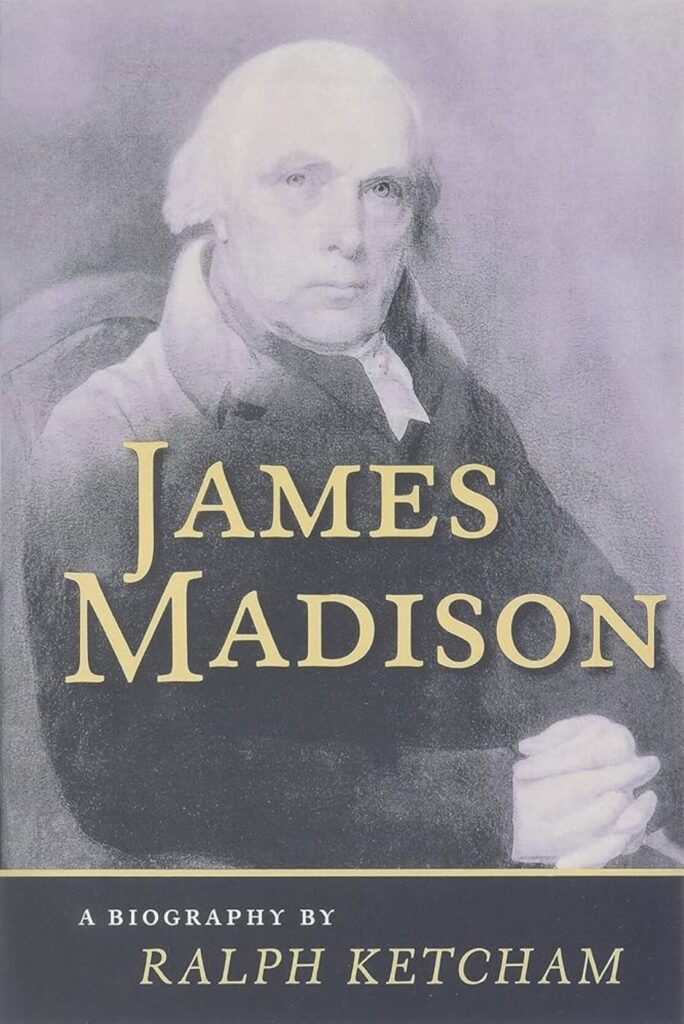
James Madison
Ralph Ketcham
Thoughts on the Biography
Ralph Ketcham’s James Madison is an extraordinary repository of information. The reader is immersed in Madison’s intellectual world. His thoughts, writings, and political calculations are covered with remarkable depth and precision. This is not a narrative-driven biography filled with dramatic cliffhangers or cinematic pacing. Instead, it is a dense, scholarly work that prioritizes understanding over entertainment.
At times, the sheer volume of detail can feel overwhelming. But for readers willing to engage deeply, the reward is substantial. Ketcham offers a comprehensive portrait of a man whose influence was foundational yet understated.
Madison emerges not as a towering personality, but as a quiet architect of American governance. His life reminds us that history is not shaped only by those who command attention, but also by those who do the hard, unseen work of thinking, preparing, and holding fast to principle when circumstances test it most.
There were pages and chapters that seemed to draw out little longer than needed and it became a bit of a slog to get through. But the reward of finishing is great. And the back half, particularly around the cause of War of 1812, was fascinating. I’m almost embarrassed to admit how little I knew of this era and war and was captivated.
The more I learned about James Madison in the previous bibliographies, the more excited I was to arrive on him. My understanding of Madison was narrow but familiar: a small, quiet man remembered primarily as the “Father of the Constitution.” Ralph Ketcham’s biography expands that image considerably, revealing Madison not as a natural-born leader or political showman, but as a figure whose influence flowed from relentless preparation, intellectual discipline, and an unwavering commitment to republican principles. Madison emerges as a man who did not seek greatness instinctively, but who rose to it through study, persistence, and an acute awareness of his historical moment.
Early Life, Uncertainty, and Intellectual Formation
Ketcham portrays Madison as someone unsure of his path for much of his early life and as a man who did not charge toward destiny but gradually “fell into” significance as events demanded his engagement. Physically unimposing and temperamentally reserved, Madison lacked the oratorical fire of contemporaries like Patrick Henry. Yet he met these met these Henry-like figures head-on, countering theatrical rhetoric with careful logic, calm delivery, and exhaustive preparation.
Madison’s intellect was his weapon. He read deeply, thought rigorously, and arrived armed with facts, arguments, and structure. His role in shaping the Constitution and co-authoring The Federalist Papers reflects not sudden inspiration, but methodical brilliance.
A humorous anecdote is provided as well. John Quincy Adams, after reading Madison’s impressment analysis, reportedly took eight days to study it before responding. The fact that someone as equal parts intelligent and educated as JQA took this time is a testament to the depth and seriousness of Madison’s thinking.
“Madison was never the loudest voice in the room — but he was often the most prepared.”
My Takeaway: Who hasn’t felt uncertain of their future? Even as brilliant as Madison was, he was unsure of where his life was headed as he came of age. Some things, it seems, don’t change by the century. Madison’s early life also demonstrates that leadership need not be rooted in charisma or certainty. Intellectual rigor, patience, and preparation can outweigh natural flair, especially in moments that demand durable ideas rather than emotional appeal.
The Constitution, Power, and Political Balance
Madison’s lasting legacy rests on his central role in crafting the Constitution. He was also, interestingly, not initially a champion of the Bill of Rights believing the Constitution’s structure sufficiently protected liberty. Yet he adapted, recognizing political reality and shepherding the amendments through Congress once their necessity became clear.
His partnership with Washington was especially significant as well. Madison drafted the addresses, responses, and key communications between the executive branch and Congress, serving as an intellectual bridge between vision and execution establishing precedent and formality of the new US government. But throughout his career and presidency, Madison found himself politically constrained, often trapped within cabinets and alliances that required constant compromise in order to preserve the delicate new nation.
“Preparation was Madison’s form of power.”
My Takeaway: Madison, for political reasons, had to install individuals into cabinet positions that may not have been his first choices. The same can be said for his selection of Generals to lead the northwest front during the War of 1812. These political handcuffs results in ineffective outcomes as best and disastrous at worst. It’s worth reflecting on how individuals perceive their current situations and how it impact their decisions. Once can’t help but wonder if Madison had the freedom to appoint whom he felt was best, would things have fared better for him and the early republic.
War, Republican Values, and Presidential Trial
Madison’s presidency tested his deepest beliefs. As a lifelong advocate of limited government and republican restraint, leading the nation through the War of 1812 forced him into uncomfortable territory. The burning of the White House stands as the most dramatic symbol of these trials and a moment of national humiliation that might have undone a less steady leader.
Yet Madison’s response was consistent with his character. He resisted abandoning republican values even under the pressures of war. Rather than embracing authoritarian measures, he maintained faith in constitutional governance. This decision shaped his enduring reputation and demonstrated to the world the power of the new nation and new government.
“Madison governed not by instinct, but by analysis.”
My Takeaway: It seems that very rarely do individuals get the opportunity to put their theories into practice, rarer still for someone to stick to those principles when easier routes are available, and possibly even rarer that it all works out in the end. Credit to James Madison for staying the course and believing in the government he had helped install. Perhaps a less principled president may have (and we’ll see in future biographies, I’m sure) pushed the limits of power to insure success.
Partnerships, Personality, and Private Strength
Madison’s reserved nature was offset by one of the most effective political partnerships in American history: his marriage to Dolley Madison. Where Madison was quiet and cerebral, Dolley was warm, dazzling, and socially gifted. She escaped a restrictive Quaker upbringing and became a magnetic First Lady, using hospitality and social grace as instruments of political cohesion.
Her famous rescue of George Washington’s portrait during the burning of the White House has become iconic, but equally important was her ability to humanize Madison, making the presidency feel accessible and unified during turbulent years.
Madison’s relationships with future presidents such as Monroe, Jackson, John Quincy Adams, and possibly William Henry Harrison also positioned him as a connective figure between founding ideals and the evolving republic.
My Takeaway: Madison’s life illustrates how complementary partnerships amplify leadership. His marriage shows that political effectiveness often depends on strengths beyond one’s own. Dolley Madison’s weekly ‘squeezes’ and political dinners helped Madison shine where he usually did not. The duo shows the power of a powerful first couple and political force.
Lessons from Madison’s Life
Ketcham’s biography yields several enduring insights:
- Preparation is power: Madison’s influence flowed from exhaustive study and readiness.
- Charisma is optional: Quiet persistence can rival rhetorical brilliance.
- Flexibility strengthens principle: His evolution on the Bill of Rights preserved both unity and liberty.
- Restraint in crisis matters: Madison maintained republican values even during war.
- Partnerships shape outcomes: Dolley Madison’s social leadership was essential to his success.
Sidebar / Quick Facts
- Madison was physically small at only 5’4” ft. and personally reserved, but intellectually formidable.
- Madison spent years unsure of his vocation and did not initially see himself as a political leader. History and circumstance pulled him forward more than ambition did
- He believed factions were inevitable and designed the Constitution to manage them rather than eliminate them
- Madison kept extensive notes during the Constitutional Convention but intentionally delayed their publication until after his death, fearing political fallout
- He was the only president to personally command troops in the field while in office, doing so during the War of 1812.
- Madison never freed all the enslaved people at Montpelier during his lifetime, despite expressed misgivings about slavery
- Madison’s reported last words were “I’ve had a change of thought.” An endearing testament that he always continued to evolve his thinking up until his death.