
John Quincy Adams: The Burden of Duty
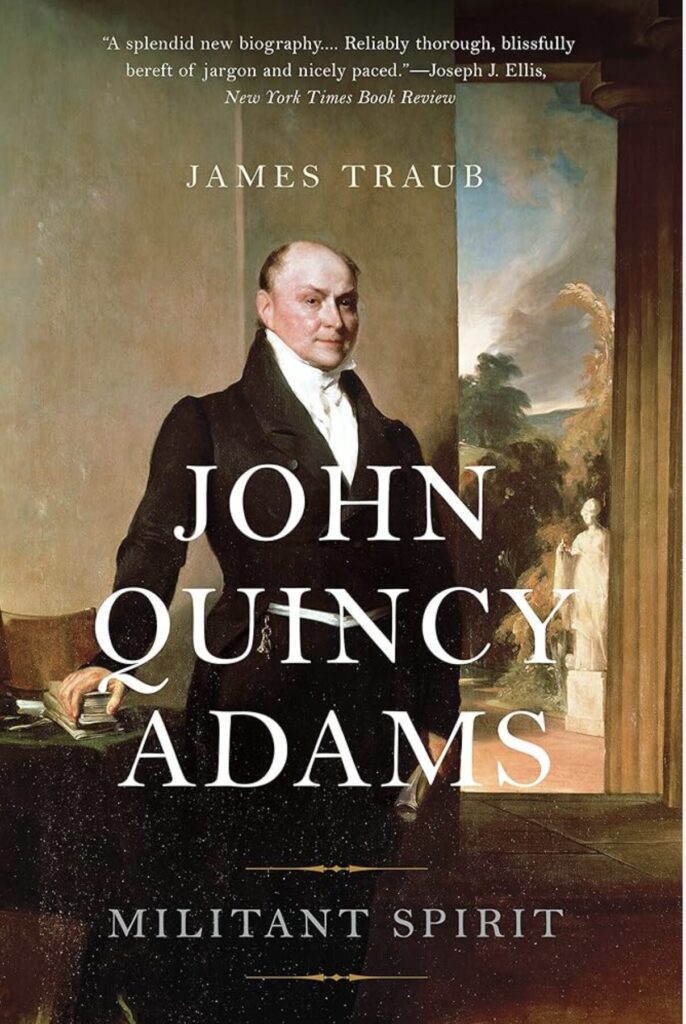
John Quincy Adams: Militant Spirit
James Traub
Thoughts on the Biography
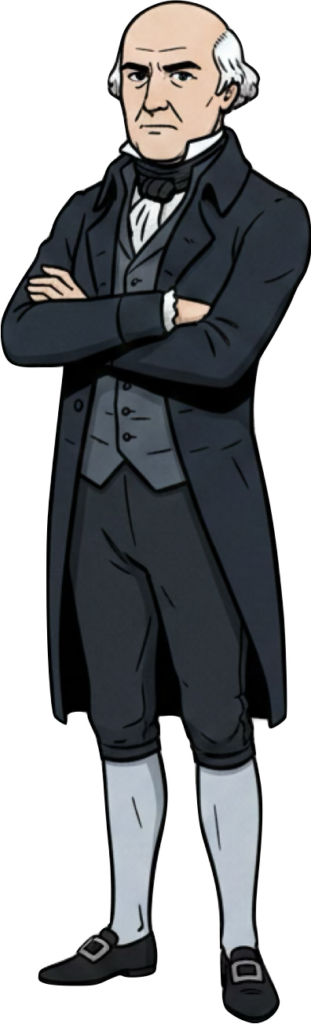
James Traub’s John Quincy Adams: Militant Spirit is a striking, often haunting portrait of one of America’s most intellectually formidable and emotionally burdened presidents. Refreshingly, Traub does not attempt to make John Quincy Adams lovable. In fact, he explicitly tells us that is not his aim. Instead, he invites admiration for Adams’ discipline, relentlessness, moral seriousness, and unwavering sense of duty.
The biography feels less like a celebration and more like a reckoning. Adams emerges as a prodigy shaped by immense parental expectations, a statesman who helped define American foreign policy, and a man whose greatest fulfillment may have come only after the presidency. Traub’s prose is smooth, insightful, and intellectually honest, making this one of the most rewarding presidential biographies I’ve read to date.
I closed the book almost feeling sorry for John Quincy Adams and the biography lingered with me for some time after finishing. It also helped me realign my own perspective on his parents, John and Abigail Adams. This power couple known in American history perhaps left much to be desired as parents. These feelings and thoughts are attributed to the excellent narrative provided by Traub.
Before reading this book, my understanding of John Quincy Adams was shaped largely by James Monroe’s presidency and a handful of trivia facts such as, most famously, Adams’ habit of swimming in the Potomac. Traub replaces those fragments with a deeply human portrait of a man who carried the invisible weight of history, family, and conscience throughout his life.
Early Years and a Prodigy in the Making
John Quincy Adams’ childhood was anything but ordinary. The son of John and Abigail Adams, he was raised not merely to succeed, but to earn his worth through intellect and service. Traub captures the extraordinary pressure placed on Adams from a young age and his ability to adapt to these pressures and opportunities. Anecdotally impressive, Adams accompanied his father on a voyage to Europe at an early age pre-revolution and learned French on the way, only to then teach English to others on the return. His parents were immensely proud, but their standards were exacting, and unconditional affection was often absent.
Adams’ brilliance was undeniable, yet it was paired with a persistent melancholy that followed him throughout his life. He belonged to the “Washington era” of politics, clinging to older ideals of disinterested service and moral restraint even as the nation moved toward popular campaigning and mass politics. Adams wanted to be president if as sense of duty to his parents and name if not his own intrinsic ambition. He carried the weight of expectation.
“He was formed by duty before desire, and the weight of that formation never left him.”
My Takeaway: Exceptional ability does not insulate one from emotional cost. Early expectations, especially when tied to identity and worth, can shape both greatness and lifelong internal struggle. John Quincy Adams felt the weight of expectations on his shoulders and his parents only added to the burden. He was highly intelligent and was provided an incredible opportunity in life… but one wonders if this opportunity meshed wish his wants.
Diplomacy, Relentlessness, and the Shape of American Power
As secretary of state, Adams was in his element. Traub portrays him as relentless, meticulous, and unyielding in negotiations. Most notably was his navigation of Andrew Jackson’s exploits and the securing of Florida from Spain. He was also instrumental in the extending of America’s western boundary toward the Pacific. He gave no ground, and he rarely softened his positions for political convenience.
The Monroe Doctrine chapter stands out as one of the strongest in the book. Traub masterfully conveys the global political climate, Monroe’s indecision, and Adams’ stubborn clarity. Rather than assigning credit to a single figure, Traub rightly frames the doctrine as the product of its time and the men who shaped it. Adams’ intellectual fingerprints were unmistakable, but the moment itself mattered just as much.
Adams also demonstrated political skill when needed. The famous “’Tis my report” episode in which he took ownership of a controversial document proved to be a rare but decisive political win.
“Adams did not bend history to his will; he argued with it until it yielded.”
My Takeaway: Enduring policy achievements are often forged through persistence and intellectual rigor, not charisma. Adams was far from charismatic but he was a skilled diplomat and able to articulate his views clearly as well as sell them in the right way. Navigating these political climates is not easy for JQA had mastered it.
The Presidency and the End of an Era
John Quincy Adams’ presidency was, by most measures, ineffective. Traub presents this honestly. Adams’ vision was ambitious, but he was ill-suited for the rising age of political machines, party discipline, and populist momentum. The emergence of figures like Martin Van Buren and the Jacksonian movement left Adams stranded in an older political world.
The 1824 election exposed the shifting landscape. Party caucuses had lost legitimacy, regional alliances mattered more, and figures like Crawford, Clay, and Jackson understood the new rules better than Adams ever would or could. His association with Lafayette during the general’s farewell tour may have reminded Americans of his patriotic lineage, but it wasn’t enough to sustain power.
Adams governed as if persuasion and idealism alone should suffice. Congress disagreed.
“He governed as a man of ideas in a world increasingly run by interests.”
My Takeaway: Leadership requires not only vision, but adaptation. The inability or unwillingness to meet political reality can render even the most capable leader ineffective. Adams is known for never compromising with congress. He can hang his hat on sticking to his principles, but unfortunately the legacy of ineffectiveness is a byproduct. It’s worth reassessing one’s own innate desire to stand on principles, when in the end, nobody wins.
Personal Life, Marriage, and Private Tragedy
Adams’ personal life is among the most tragic elements of the biography. His marriage to Louisa Catherine Adams feels distant and strained, marked by duty more than warmth. One cannot help but wonder whether Adams’ early heartbreak, combined with the emotional discipline instilled by his parents, limited his capacity for intimacy.
The deaths of his children (one by drowning, another by an unclear illness) compound the sense of quiet sorrow that permeates his life. Louisa herself endured immense hardship, including the loss of her infant daughter and years of emotional isolation. Traub portrays her sympathetically, noting that she found her voice only later in life.
John Adams (2nd president and his father), by contrast, emerges in this biography with renewed admiration. He was a proud and engaged father, a willing intellectual sparring partner to John Quincy, and a kind, accepting father-in-law to Louisa.
“The public man was iron; the private man was often alone.”
My Takeaway: Personal fulfillment does not automatically accompany public success. Even those who achieve greatness may carry profound private loneliness. I was captivated by the personal gloom that John Quincy Adams always seemed to had. What’s more, it seemed warranted. Rarely has a historical figure elicited such empathy from me, especially someone who was provided with so much opportunity (and even capitalized upon). It seemed to deterministic for John Quincy Adams while standing in contrast to his inner desires.
Redemption in the House and a Legacy Reclaimed
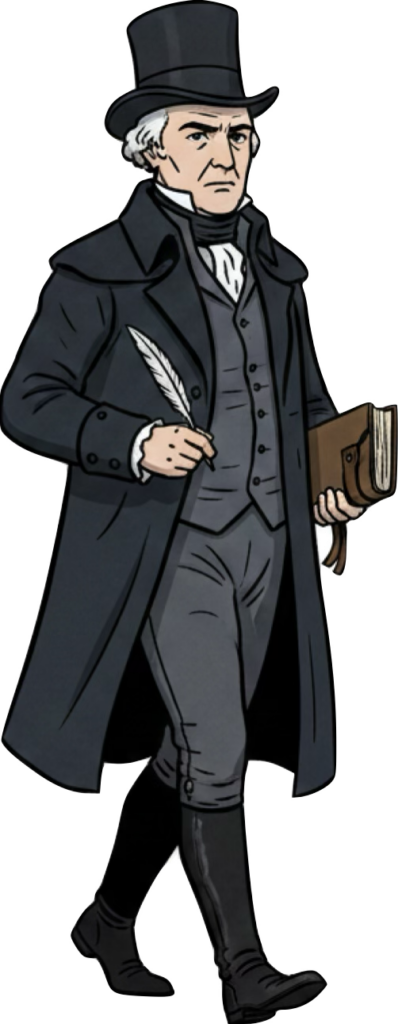
Adams’ true calling seems to come after the presidency. His decision to serve in the House of Representatives (unique among presidents) gave the nation a “sober second thought” about his legacy. There, he became a relentless opponent of slavery, challenging the South and battling the gag rule with moral courage and intellectual force.
He did not seek civil war, but he refused silence. His willingness to stand alone in defense of principle ultimately reshaped how he is remembered.
Adams died on the floor of the House, still serving the republic. It was, in many ways, a fitting end. He had dedicated his life to public service at the expense of intimate relationships.
“Duty did not leave him when power did.”
My Takeaway: Redemption is possible at any stage of life. Legacy is not fixed by titles held, but by principles upheld. He had reached the pinnacle of politics only to fizzle out as ineffective. But it seemed then that a weight had been taken off his shoulders and he was free to apply his skillset and intellect in a manner that was more suitable to him. It was good to see him find (self) redemption in the later part of his life.
Lessons from John Quincy Adams’ Life
- Duty can be both a strength and a burden: Adams’ life shows the cost of living almost entirely for obligation.
- Intellect shapes history: From diplomacy to antislavery advocacy, ideas mattered deeply in Adams’ career.
- Political eras change: Leaders who fail to adapt risk irrelevance, regardless of talent.
- Moral courage outlasts office: Adams’ House service ensured his legacy would endure.
- Success is subjective: Adams may never have felt fulfilled, raising timeless questions about how we define a successful life.
Sidebar / Quick Facts
- Adams famously swam in the Potomac, walking an hour to the river and swimming for hours. Far more than a simple novelty, it refreshed his body and mind.
- John Quincy Adams spoke multiple languages fluently, including French, Dutch, German, Russian, Spanish, and Latin.
- Famously stated “… she goes not abroad, in search of monsters to destroy.” Later quoted by future politicians.
- Presidency and reputation suffered somewhat from the “Corrupt Bargain” that allegedly placed Henry Clay as Secretary of State in his exchange for support.
- He kept an extensive daily diary for over 60 years, totaling more than 14,000 pages, which remains one of the richest primary sources in early American history.
- He was obsessed with weights and measures, producing a strangely detailed report that reflected his methodical mind.
- No other president served in the House of Representatives before or after him.
- His final words, after collapsing on the House floor, were reportedly: “This is the last of earth. I am content.
- He died while still serving in Congress, underscoring a lifetime devoted to public service.
- Freshman congressman Abraham Lincoln served as pallbearer.



One Comment