Thomas Jefferson: Principles Meet Power
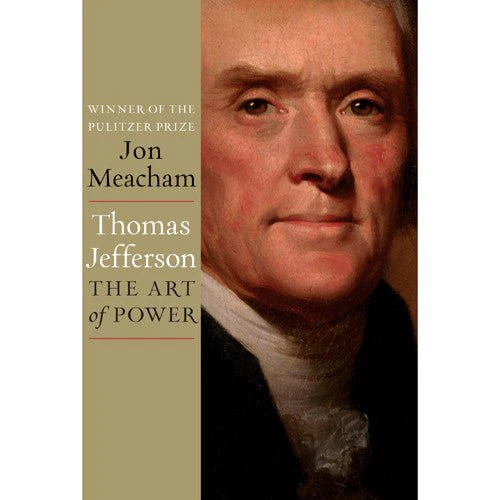
The Art of Power
Jon Meacham
Thoughts on the Biography
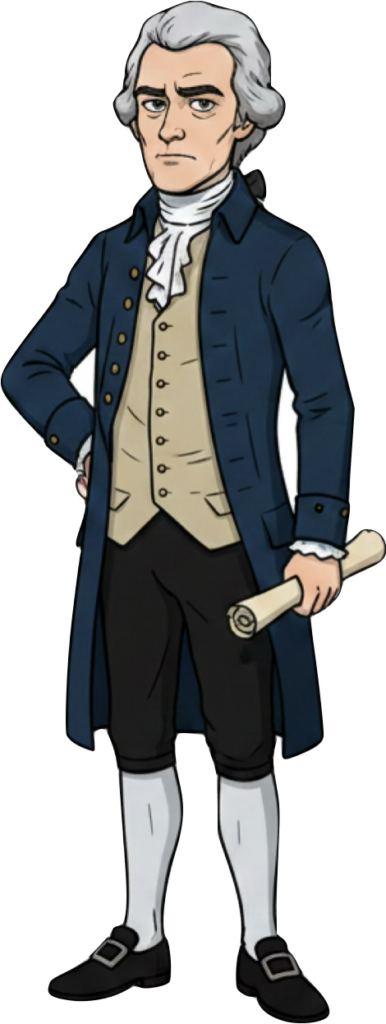
The Art of Power presents Jefferson not as an enigma or a marble statue, but as a richly human figure. He was brilliant, contradictory, strategic, and deeply sensitive to the currents of political life. Meacham’s writing illuminates Jefferson’s masterful ability to shape events through persuasion and careful timing, revealing a founder who wielded influence with delicacy and calculation rather than force or bluster.
For readers, Jefferson becomes a study in how ideas and personality can combine to create lasting impact. Jefferson was brilliant and he used this brilliance to assess both the creation of the US government as well as how to utilize it. This balance helps lends itself to Meacham’s title. Meacham also finds the correct balance in accentuating Jefferson’s strengths but not apologizing for his failures. And as these failures do not erase Jefferson’s achievements, nor do his achievements absolve his failures. Instead, Meacham articulates how they coexist, offering a textured portrait of a man whose complexity shaped the nation he helped build.
It is worth pointing out that the style and tone felt a bit jarring after Washington and Adams biographies. Meacham takes a more narrative and story-book feel, using descriptive words to set tone as opposed to assuming the reader has a historical setting. But these are best-sellers for a reason. It was easy to get into the groove of reading once starting.
Before reading The Art of Power, my understanding of Thomas Jefferson centered on a few broad themes: the Louisiana Purchase, his lifelong financial troubles, and the complicated legacy of Sally Hemings. But Jon Meacham’s biography presents a far richer and more intricate portrait. In it is a man of extraordinary intellect and equally extraordinary contradictions, someone who wielded influence not through force or charisma alone, but through subtlety, persuasion, and an almost artistic sense of political timing. Jefferson emerges as a figure whose power was exercised quietly yet effectively, shaped by charm, adaptability, and an unwavering belief in ideas.
Early Life, Personality, and Intellectual Formation
Meacham traces Jefferson’s development from his upbringing in Virginia through his early roles in revolutionary politics, revealing a man whose gifts were less martial than philosophical. Unlike Washington, Jefferson did not distinguish himself in military command; in fact, when the British invaded Virginia, he fled. An act that damaged his public reputation but is consistent with his lifelong disposition away from confrontation.
What Jefferson did possess was a remarkable mind. He sparkled as Secretary of State, dazzled as the primary author of the Declaration of Independence, and cultivated tastes that ranged from architecture to violin performance. His meticulous weather notes, detailed correspondence, and refined sensibilities reveal a deeply curious and aesthetically driven personality.
“He sparkled where intellect, elegance, and imagination carried the day.”
My Takeaway: History loves the loud heroes who roar in the face of danger. Jefferson’s brandished a different type of sword. His mind, coupled with his personality, glowed bright even before he was thrust into the center of politics. He was also charming in intimate settings, illuminating that individuals are complex. They can be both confident and reserved and each can be used to influence and lead.
The Art of Power: Principles and Pragmatism
A major theme in Meacham’s biography is Jefferson’s paradoxical relationship with executive authority. He was a lifelong advocate for limited government and a skeptic of strong centralized power. Yet, once president, he demonstrated a striking willingness to stretch constitutional boundaries when opportunity aligned with national interest.
The Louisiana Purchase stands as the clearest example. It was a bold, constitutionally ambiguous move that doubled the nation’s size. Jefferson justified the act as pragmatic necessity, revealing a political philosophy that was flexible in execution even when rigid in theory.
“Jefferson opposed concentrated power — until he needed it.”
My Takeaway: Jefferson embodies the tension between ideals and reality. Effective leadership often requires adapting principle to circumstance, recognizing that strict adherence to doctrine can sometimes hinder the greater good. His presidency underscores that pragmatism, when aligned with civic purpose, can be a form of political wisdom. It’s fascinating how Jefferson clings to republican principles but can wield power when it suits him… and all the more fascinating how he’s celebrated for it as opposed to lamented. Contrast those with James Madison who stuck to republican principles even during the War of 1812. Two approaches, similar outcomes.
Diplomacy, Image, and the Power of Style
Jefferson understood that influence could be exercised through tone, posture, and presentation. This is perhaps best captured in the famous episode of receiving British ambassador Anthony Merry while wearing slippers. This act was interpreted by Britain as disrespectful but was meant by Jefferson as a simple, symbolic republican informality.
Such moments illustrate how Jefferson practiced power through gentleness rather than spectacle. He favored conversation over confrontation, courtesy over authority. This understated approach could confuse or offend those steeped in European and monarchical protocol.
“He carried power lightly, but never casually.”
My Takeaway: I was equal parts amused and equal parts embarrassed in the recalling of how Jefferson received Anthony Merry. But it’s also telling that in other intimate settings, people were enraptured by his charm. It’s difficult to ascertain exactly who Thomas Jefferson was without concluding that he was who he needed to be in specific situations. Unsurprisingly, he seemed to calculate the moment and apply the side of him needed for success.
Relationships, Affections, and Private Contradictions
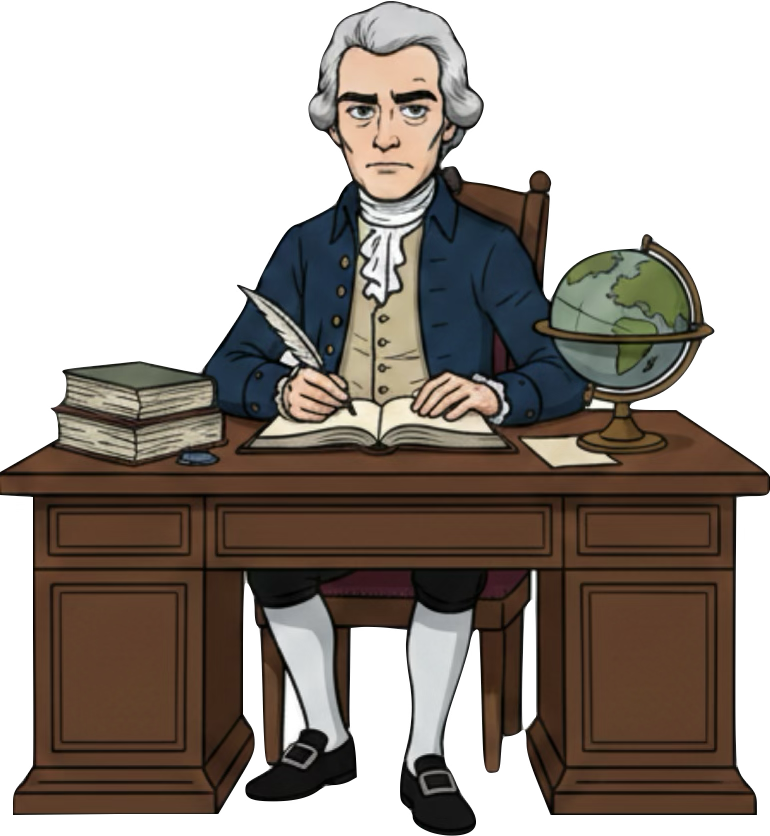
Meacham gives careful attention to Jefferson’s personal world, particularly his marriage to Martha. Their relationship appears to have been genuinely affectionate and stabilizing, and her early death left a lasting emotional void. Jefferson never remarried, a testament to the depth of their bond.
At the same time, Jefferson’s relationship with Sally Hemings and the enslaved population at Monticello remains one of the most challenging elements of his legacy. His soaring proclamations of liberty coexisted with the reality of enslavement which is still today a contradiction impossible to reconcile cleanly.
“He sought beauty and grace, yet lived with enduring contradictions.”
My Takeaway: Jefferson’s private life highlights the complexity of historical figures. Great intellect does not insulate a person from moral failure, nor does moral failure negate intellectual greatness. Understanding Jefferson requires a willingness to engage both truths simultaneously. Like nearly all founding fathers, the preservation of the union superseded the importance of eliminating slavery. And like most of the founders, this reconciliation benefited them as slave owners themselves. It’s a difficult contradiction to absorb, but there’s a level of understanding, as sober as that may feel.
Lessons from Jefferson’s Life
Meacham’s biography offers several enduring lessons that extend beyond historical study:
- Power can be subtle: Influence often flows through persuasion, charm, and intellectual authority rather than overt force.
- Ideals must meet circumstance: Jefferson shows that principled adaptability can be essential in leadership.
- Relationships shape governance: His evolving bond with John Adams demonstrates that rivalry, respect, and reflection enrich political life.
- Presentation matters: Jefferson’s mastery of image and tone reveals that leadership is as much about how one carries power as how one uses it.
- Human complexity must be acknowledged: Jefferson’s brilliance and his contradictions cannot be separated; each informs the other.
Sidebar / Quick Facts
- Founded the University of Virginia. It was one of Jefferson’s proudest achievements; he designed the buildings, shaped the curriculum, and saw it as his lasting gift to the nation.
- Monticello was designed as a personal haven. He obsessed over every detail, from skylights to wine dumbwaiters, treating architecture as an extension of the self.
- While in France, Jefferson injured his wrist attempting to impress (or escape a romantic encountering from) Maria Cosway by jumping over a fence. The wrist never healed properly and bothered him for the rest of his life.